

Jordan release: the history, the iconic models, and the upcoming drops
The Jordan are not sneakers like the others. A blessing and a curse for every sneakerhead, Nike Jordans are the shoes that, over time, have become the reference sneakers for athletes and collectors worldwide. At Urbanstaroma, starting this month, you will find a wide selection of Jordan sneakers. Before announcing the most exclusive models and drops, let's retrace the history of this milestone in the streetwear world. From the basketball world to contemporary street style phenomena, it's time to rediscover the impact of these sneakers.
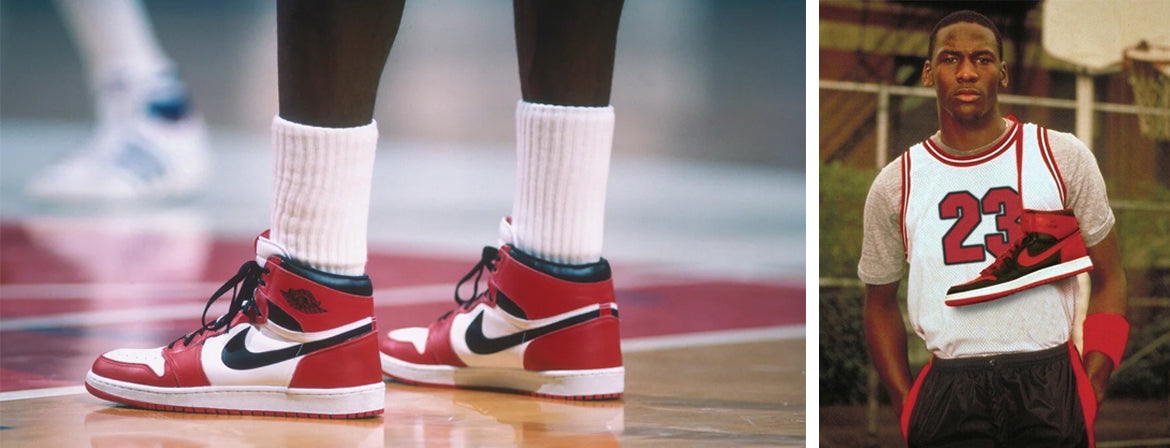
The story of Jordan: more than a sneaker, a legend
The birth of the Air Jordan is a story that begins in 1984, when a young Michael Jordan - then a promising player for the Chicago Bulls - signed an unprecedented contract with Nike. From here was born one of the most iconic and successful sportswear lines of all time. The Air Jordan 1 was launched on April 1, 1985, and sold for $64.99. Nike expected to sell 100,000 pairs in the first year but, against all expectations, shipped 1.5 million pairs of Jordans in the first six weeks, reaching $26 million in the first year. Since 1997, the Jordan brand has become a standalone label, also including a clothing line with hoodies, tracksuits, underwear, and suits appreciated worldwide.
Another curiosity about these sneakers concerns the designer who created the first silhouette: although many Jordans were created by the well-known Tinker Hatfield (designer of the Air Max 1 and Air Huarache), the Air Jordan 1 was designed by Peter Moore, a less known name at Nike. Moore designed the shoe with the contribution of Michael Jordan himself, who expressly asked for something flashy and low so he could feel the court under his feet. Moore also included a compressed air sac in the sole to cushion the impact. The New York Times described the new shoes as "similar to space boots," marking the beginning of a new era of street style. Before that, most sneakers on the market featured the classic black and white design. With the release of the Jordans, Moore aimed to design a shoe where color was the protagonist. Thus, the first Jordans featured red, black, and white, the colors of the Chicago Bulls franchise.

Why the shoes are called Jordan and what OG means
The shoes are named after Michael Jordan because Nike, at the time, decided to bet everything on him to create a line of footwear that would bear his name. Jordan was not only an exceptional athlete but a true cultural phenomenon, a player who was rewriting the rules of basketball with his undeniable talent and charismatic personality. The impact he had on the NBA and popular culture was so profound that Nike recognized the potential of a partnership that went beyond a simple endorsement. Creating a line entirely dedicated to him meant binding the product inseparably to his greatness, guaranteeing an aura of prestige and desirability like no other.
In the Jordan world, the acronym OG stands for "Original." It refers to the original versions of the shoes, those that were released for the first time. OG versions are often the most sought after by collectors for their authenticity and for the direct connection to the model's history and Michael Jordan's performances. When talking about a "Jordan 1 OG," for example, it refers to the design and materials of the model's first release, which distinguishes it from subsequent reissues or interpretations.

How many Jordan models exist in the world?
The Jordan universe Jordan is incredibly vast and constantly expanding. Beyond the famous numbered line that goes from the Jordan 1 to the very recent Jordan 38, the brand has expanded with a myriad of lifestyle variants, exclusive collaborations, and, above all, the beloved Retro versions.
The main series include:
Numbered line: these are the "main" models, released year after year, often coinciding with Michael Jordan's NBA seasons. Each number represents an evolution in design and technology. Every new Jordan shoe brought new innovations. The Nike Air bubble on the III, the reflective tongue on the V, the mesh upper on the XI.
Retro: Retro versions are reissues of the original numbered models, often with small modifications or adaptations to modern materials, but always faithful to the historic design. They are the most coveted by fans and collectors.
Special editions and collaborations: these Jordans include models created in partnership with artists, designers, or other brands, often featuring unique designs and limited runs. Designers including Kim Jones of Dior and Virgil Abloh of Louis Vuitton have "elevated" the Air Jordan 1 to a high-fashion item of great value.
Low, mid, and high variants: many iconic models are released in different upper heights (low, mid, high), offering options for every style preference and use.
Each Jordan model has its own value, story, and cultural impact, helping to make the brand an unmatched point of reference in the sneaker world.
Jordan models that made history
Among the wide range of Jordan models, some stand out and have stood out for their impact on the street style scene and their global success. Here are a few:
J 1: the shoe that started it all. Released in 1985, it became famous not only for its bold design but also for being initially banned by the NBA due to its red and black colorway, which violated uniform rules. Every time Michael Jordan wore them, Nike paid a fine, generating incredible publicity and making the shoe a symbol of rebellion. It remains one of the most desired sneakers today.
J 3: a model that marked a turning point. Released in 1988 and designed by Tinker Hatfield (a well-known figure at Nike offices), the Jordan 3 introduced the iconic "elephant print" and the visible Air unit in the heel. It is the shoe with which Michael Jordan won his first MVP, his first DPOY (Defensive Player of the Year), and the legendary 1988 Slam Dunk Contest, with the famous leap from the free-throw line.
J 4: launched in 1989, the Jordan 4 cemented Hatfield's fame with innovative features like plastic "wings" for ankle support and breathable mesh. It also became famous thanks to Spike Lee's film "Do the Right Thing" and saw Jordan make the legendary "The Shot" against the Cleveland Cavaliers in the 1989 playoffs.
J 11: Considered by many one of the most beautiful Jordans ever, the Jordan 11 was introduced in 1995. It revolutionized basketball shoe design with the introduction of "patent leather" on the upper, giving it an elegant and distinctive look. Michael Jordan wore them during the season when the Bulls reached the record of 72 wins and won the NBA championship, cementing them in history. "My impression was that Michael Jordan had already secured a position in the market beyond sports. It didn’t matter whether he was on the court or not," explained Tinker Hatfield, designer and creator of the Jordan 11. As a creative and true innovator, Hatfield followed his instinct and began working on what would become "The Grail": the eleventh Air Jordan.
Where to buy Jordans: available on Urbanstaroma
If you are looking for the latest releases or the most iconic models, Urbanstaroma is your go-to reference. Starting from June 2025, Urbanstaroma will have an exclusive selection of Jordans, offering both historic models and new releases. With a particular eye on trends and limited editions, Urbanstaroma is a must-visit for all sneakerheads who want to stay updated on the latest news and secure the most coveted Jordans.
Jordan Drop: what to expect from the June 2025 launch
Jordan is betting everything on 2025 and its line of retro reissues. With the confirmation of timeless classics like the Black Cat 4s, the Air Jordan 1 "Bred," and the recent release of the Black Cat 3s, Jordan aims to regain the trust of its loyal followers with the reissue of some of the most celebrated Air Jordans in history. Among these are the Air Jordan 5 "Grape".
Air Jordan 5 Retro OG Grape: the June release
Originally launched back in 1990, the Grape Jordan were among the first models with non-traditional colors in the then emerging Air Jordan legacy. Moving away from the color formulas associated with the Chicago Bulls, Nike began offering its signature shoe line in new color styles to expand its range. Culturally, the Air Jordan 5 "Grape" are perhaps best known for their numerous television appearances, especially in the popular show "The Fresh Prince of Bel-Air" starring Will Smith.
After the original launch in 1990, the Grape Jordan 5s were absent from the sneaker market until 2006, then returned to prominence in 2012. A laceless version of the shoe was then released in 2018 as a tribute to the relevance of the successful '90s sitcom. The 2025 launch of the Air Jordan 5 "Grape" promises a shape faithful to the original, making this Jordan release particularly sought after by the Jordan community.


